Global climate Understanding Earth's climate system or the bible of CO2 non-warming By Dr J Floor Anthoni (2010)
www.seafriends.org.nz/issues/global/climate.htm
(This chapter is best navigated in a normal page-width window, and
by opening links in a new tab of your browser)
.
.
The Internet is abuzz with global warming
issues which have polarised those who believe that humans are causing catastrophic
global warming against those who believe this is not so. A United Nations
panel (IPCC) was established to study the matter in order to advise governments
of necessary action. Then Climategate exposed how this small group
of people defrauded the truth. All this time an urgent need existed for
a web site that clearly and concisely explains how the planet's climate
works and how it varies, yet in a way that ordinary people can understand,
while totally devoid of politics, beliefs and ulterior motives. Read on
- with care.
Planet Earth 'hangs' by an invisible thread between a sun of 6000ºC
and outer space of -273ºC, reason why its temperature cannot be constant.
Yet, miraculously it is more stable than expected. (37 pages)
Water is the strangest substance on Earth and also the most common.
Not surprisingly it plays a decisive role in weather and climate. Even
so it is grossly misunderstood and underestimated. (19 pages)
Measuring temperature is not as easy as it seems,
and measuring past temperatures of thousands and millions of years ago,
even less. Learn about the types of fraud committed to temperature data.
(38 pages)
It is widely believed that cumulative burning of fossil fuels has upset
the climate to such extent that catastrophic global warming could follow,
but what is the story? (31 pages)
Higher levels of carbondioxide are beneficial to plants and the world
at large. This page examines the ecology of carbon, plant ecology and how
scientific growth experiments are done. Examples of important plant species
are provided. (12 pages)
What is normal global climate change? A question we should have asked
in the first place. Now with the legacy of the late Dr Joseph Fletcher,
there is an answer: the change in wind strength over a 174 year cycle.
Very important reading because it provides new insight. (15 pages). Dr
Fletcher's lecture (2001) (24 pages)
Many believe that increasing levels of CO2 will acidify
the seas with disastrous consequences for sea life, but is this true? Threat
or fraud? How can one understand it? (large)
Soil is our most precious and also most abused resource. How is it
formed, how does it work and what does it need? What lives on it, where
why and how? How are we losing it and what must we do? (large)
Climategate has exposed corrupt scientists and their institutions.
Here we mention names in order to hold them accountable. Lest we forget;
we owe it to our children. We also dissect some utterly disgraceful articles
and statements from the scientific establishment. (22 pages)
www.uoguelph.ca/~rmckitri/research/ISPM.pdf
- Independent Summary for Policymakers of the IPCC Fourth Assessment
Report (Working Group 1) (64 pp) An alternative and more realistic
summary than that of the IPCC.
A concise history of the greenhouse effect, by Timothy
Casey: http://greenhouse.geologist-1011.net/,
describing the work of Fourier, Tyndall, Arrhenius and others, also clearing
up some misunderstandings, showing that CO2 has no effect.
www.aip.org/history/climate/
- the history of climate research. by Spencer Weart with many links.
Note a pro-AGW site! Large and detailed but somewhat naive.Historical gems.
www.climate4you.com/
a treasure trove of climate data and explanations. Reliable.
Note! for best printed results, read tips
for printing. For corrections and suggestions, e-mail
the author.
The whole section covers about MB, including text, drawings
and photographs. Buy our CD or make
a donation.
-- Seafriends home -- -- Rev:20100825,20101029,20110327,20110416,20111220,
Introduction The climate, and with it temperature, is of critical
importance to the functioning of society and people's well-being. Because
a human generation lasts no longer than 60 years, excluding early childhood
and senility, we see only a short period of the courses that climates are
taking. So we are inclined to think that the world around us remains in
a steady state, that tomorrow is like yesterday. And indeed, the world's
climates have been remarkably steady.
But recently, we have been witnessing some warming, while at the same time
the awareness arose that perhaps we, ourselves, were the cause of this
warming. The obvious culprit is thought to be carbondioxide emitted by
industry and our comfortable way of life because it has long been known
that it blocks part of the 'thermal' infrared radiation. For example, our
'sister' planet Venus has an atmosphere consisting of carbondioxide, and
its temperature is very much higher than expected, measuring over 400 degrees
Celsius, more than enough to melt lead. So more and more people became
concerned that the same fate, run-away global warming, may befall
Earth, or Catastrophic Anthropogenic Global Warming (CAGW).
It didn't take long before the vast majority of people were drawn into
this scare scenario, predicting catastrophes from melting ice caps, rising
sea levels, floods, diseases spreading, loss of species, dying corals and
sea life, and much, much
more. World conferences were organised to jolt politicians into action,
which led to the inauguration of the Inter-governmental Panel on Climate
Change (IPCC) to advise what is happening, how serious, and what to do.
In the meantime, the World Wide Web matured, reaching billions of people
with millions of pages of scary predictions. There appeared universal consensus
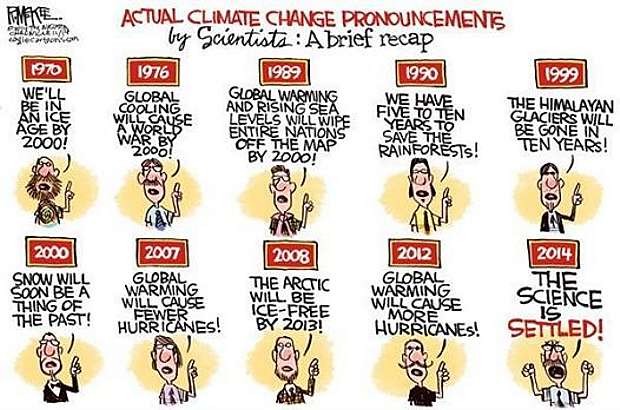
(by the 'warmists') that 'the science was settled' and that it was now
time for action - very costly action.
IPCC: The greenhouse effect is real; it
is a well understood effect, based on established scientific principles.
However, in reality, the science is far from settled, and skeptical
scientists (the 'skeptics') who had been blocked from the scientific process,
began to use the Internet to disperse criticism and alternative observations
and explanations.
"It's very disturbing that we do not
understand the climate on a planet [Venus] that is so much
like the Earth. It is telling us that we really don't understand the Earth.
We have ended up with a lot of mysteries." - Professor Fred Taylor,
a planetary scientist based at Oxford University and one of the ESA's chief
advisers for the Venus Express mission
This is where I became involved, and from here on, this introduction
is about my (Floor Anthoni) personal motivations and observations. Rewind
to 1987 when I began to realise that the seas around New Zealand were degrading
at an accelerating rate. It motivated me to stop doing what I did (computers
and electronics) and to begin 'saving the sea'. That meant a lot of re-schooling
(in marine ecology). I soon realised that education was the key to conservation
because we need to learn more before we can 'do the right thing for
the right reasons at the right time'. In 1997 the Internet led the
way, and I began writing this very large educational web site. My aim is
'accelerated learning' such that the reader can learn 100 times faster
than I did.
With very large chapters like oceanography,
soil,
degradation
and ocean acidification already completed, a large
chapter about climate and global warming was just the next step. I expected
that this would have been done by someone else a long time ago, but to
this day, there is no web site that could qualify. Sure, there are scores
of extensive web sites, both in the 'warmist' camp and in the opposite
camp, but one can easily get lost in the way they confuse. A site is needed
that provides critical step-by-step learning, while dissecting the science
and throwing challenges in as well, and all that without bias. But you
need to open your mind, because there is a lot of science to learn, and
many new viewpoints discovered by myself.
It is impossible to begin to learn
that which one thinks one already knows.
So here it is. This section is split into seven new chapters added
to three already existing ones, completing the trilogy of land, sea and
air:
Chapter 1: Marble in space. The world hangs by an imaginary thread
between the hot sun and cold space. It has managed to stabilise its temperature
somewhat but large swings (the ice ages) are still there. Here you'll learn
about imaginary atmospheres to understand ours, and about albedo, Milankovic
cycles, the restless sun, the influence of cosmic radiation and other influences.
You will also learn about the major faults in the IPCC's theory of heat
transfer by thermal radiation. The debate about global warming from carbondioxide,
should have ended here.
Chapter 2: Water, ice and vapour. Water is the strangest, yet
most common substance on Earth. Many of its strange properties are what
stabilises the climate, causes ice ages, and most importantly, on which
life depends. You'll learn about its physical properties, humidity, latent
heat, ice shelves, glaciers and ice ages. Much of this chapter contains
'old' knowledge, presented in a new way.
Chapter 3: Measuring temperature. It is surprisingly difficult
to measure temperature in a way that matters to understanding climate and
its changes. You'll learn about thermometers, the Stevenson Screen, Urban
Heat Island effects, weather balloons, paleothermometers, proxies and where
the heat content of Earth is found. You will also learn about the massive
frauds that have been committed to make it seem that Earth is warming faster
than ever before.
Chapter 4: Anthropogenic global warming, or how fossil fuels
are thought to warm the planet and cause climate change. You'll learn about
the IPCC and its computer models, to discover that a massive fraud is in
the making. You'll learn about hockey stick graphs and the basis of proof
offered by the IPCC. You will learn about the science in support of AGW
and where it fails or leaves doubt. Also in this area there has been much
deliberate fraud.
Chapter 5: Greening planet. Both rising temperatures and rising
carbondioxide concentrations are very beneficial to all life. Here you'll
discover the positive sides of carbondioxide and how plants react.
Chapter 6: Miscellaneous gems from the Web. Now and then a gem
of wisdom is found in blogs, comments and other postings, here saved for
posterity. An interesting read but you can skip it if you like.
Chapter 7: What is natural climate change? What natural climate
forcings have been working long before humans existed, and how do these
influence the climate? Do they explain recent warming and future cooling?
Do they refute the global warming scare? This chapter is based on the seminal
work of Dr Joseph Fletcher whose seminar (Jul 2000) has been reproduced
here,
in his own words. The wind factor has been overlooked by the scientific
community. Very important reading and uniquely, only on this site!
Chapter 8: Hall Of Shame. Science deals with facts, experiments
and numerical representations of the natural world around us. However,
the "science" of global warming does not. Instead of global
climate changes are presumed to be natural, unless and until specific evidence
is forthcoming for human causation, the proof is reversed to
global
climate changes are presumed to be due to human-related carbon dioxide
emissions, unless and until specific evidence indicates otherwise.
With tens of thousands of scientists uncritically in the "warmist" camp,
the whole of science has been corrupted beyond repair.
If
experiment disagrees with the hypothesis, the hypothesis is wrong.This
chapter shows you how rotten science has become. Also read Dr Bob Carter's
analysis
Don't miss out reading the other chapters as well:
Ocean acidification: the scare industry migrated from global
warming to climate change to ocean acidification but
here you'll discover how the ocean's chemistry really works, what is known
and not known, and why so many experiments have been fraudulent.
Oceanography: about the oceans, the biggest part of Earth by
far. You'll discover how waves work, tides, storms, dunes and beaches and
much more. This also contains the circulations of water and air and how
climate and weather are formed around the world.
Soil: this very large chapter introduces you to our most important
resource, how it is formed, what lives on it and where and why, and how
we are losing both its quality and quantity, and what we must do. It also
makes you understand the major biomes/habitats in the world. When all is
said and done, our major concern should be with the loss of soil and water.
Conclusion? A conclusion is not needed. Just let the facts speak
for themselves, try to UNDERSTAND and make up your own mind. Is the IPCC
report accurate, inaccurate or fraudulent? Is climate understood, poorly
understood or misunderstood? Is 'climate change' natural or caused by humanity?
Is warming inconsequential, worrisome or catastrophic? Is the science (knowledge)
settled, not settled, mainly absent or corrupted? Etc.
In no other branch of science is the
science 'settled' or the evidence 'incontrovertible'. This is strong evidence
that Climate Science is not science at all.
I am indebted to the many scientists who often spent their entire career
trying to extract meaningful data from the past. I have also been fortunate
with the development of the Internet and am equally indebted to so many
people who shared their ideas so unselfishly. Yet so much confusion has
been caused and spread by so few dishonest people.
Thousands of papers have been published,
yet so very few are worth citing.
Finally, don't be intimidated by the amount of time needed to study
all of the above. Think for a moment how much time it has taken me to put
it all together and for thousands of scientists to deliver the data. I
have included many drawings and graphics so you won't need to worry about
the calculations. Even so, it is only natural to read some of it several
times. Spend time studying the graphs because they have great stories to
tell. And if there are things that are not quite clear, or should you find
mistakes,
e-mail me so that it can be fixed.
If these chapter were useful to you, tell others, as many as you can
and as soon as you can. Link to this chapter from whichever website. If
you are financially comfortable, consider making a donation.
Together we can make a better world.
we need to do the right thing for the right
reasons at the right time, because we owe this to our children
- Floor Anthoni
Disclaimer I am not a climatologist
but have a keen eye for observation, a wide interest in science and a critical
mind trained in analysing big problems, breaking them apart and finding
the rules within. I am not paid by anybody. This is a labour of love, a
gift to future generations.
Floor Anthoni, May 2010.
A divided
world The global warming scare
has divided the world unevenly into three camps: the warmers, the
warm
skeptics and the cool skeptics. It is an indication that the
science is not at all settled, as claimed repeatedly by the warmists.
The warmists The warmists believe
that Earth's surface and atmosphere are cooled by out-radiation, warmed
by re-radiation and back-radiation, as proclaimed by the UN IPCC. Their
hypothesis states that CO2 increases back-radiation and thus temperature.
Worse still, they assume that a slight warming releases more of the natural
warming gas water vapour and that this causes positivefeedback
(amplification).
When programmed into their computer models, predictions of warming become
indeed quite dire, reasons to be extremely worried, they say. About 99%
of the world and nearly 100% of the media support this, and banks too,
as they see the trade in carbon credits as a sorely needed new financial
bubble and cash cow. Literally tens of thousands of scientific articles
and tens of millions of news articles, blogs and comments are based on
this hypothesis. Yet no effect has ever been measured
- Keep this in mind!.
The warm skeptics The warm skeptics
(my terminology) believe in the IPCC warming hypothesis but think that
the warmists exaggerate their claims. Instead of 3.5ºC for a doubling
of CO2, their estimates are 0.7-1.5ºC. These people are still in a
very small minority and are not backed by the media, neither do they share
in the rich CO2 handouts/subsidies. These people also point out that more
CO2 is good for everyone including nature, and so is some warming up to
5ºC. Some 30,000 scientists signed a statement to that effect. No
reason to worry.
"The influence of mankind on climate is
trivially true and numerically insignificant." Richard Lindzen
The cool skeptics The cool skeptics (my term)
claim that CO2 has no effect on temperature whatsoever. They arrive at
this conclusion by understanding the physics of the atmosphere which insists
that the surface and the lower atmosphere do not cool by out-radiation
etc, but by contact, conduction and convection. The cooling rate is indeed
identical to that of the planet Venus which has an atmosphere of nearly
100% CO2 (2500 times as much). They are backed by several hard facts, but
their numbers are indeed very small, too small to be heard.
The whole irony of the
global warming debate is that this very small group is right and the rest
(99.99%) are wrong. Isn't that interesting? Imagine tens of thousands
of scientific publications ready for the dustbin and trillions of dollars
mis-spent and lost for future generations and the poor? A whole generation
of children scared for nothing? Perhaps this may fire you up to read our
large climate chapter from beginning to end.But the scary IPCC predictions
did not happen:
* Global
temperature is rising more slowly than IPCC’s least estimate; No rise
for 18 years.In 20th century not exceeding natural variation.
* Sea
level has been rising for eight years at slowest rate, just 1.3 inches(3cm)/century;
Atolls
will not drown * Ocean
heat content has barely risen in 6 years;There is no invisible heat
store * Hurricanes
and tropical cyclones are quieter than for 30 years; No catastrophic
climate change * Global
sea-ice extent has changed little in 30 years;Antarctica has expanded.
* Methane
concentration is up just 20 parts per billion since 2000; Flattening
out * The
tropical hot-spot in the upper troposphere the IPCC predicts
as our footprint/smoking gun is absent;
* Outgoing
radiation is escaping to space much as usual. No measurable change * CO2
follows
temperature and not the other way, both seasonally and in ice ages.
Thus CO2 does not cause warming.
The whole irony of the global warming
debate is that 99.99% are wrong. Isn't that interesting? - Floor
Anthoni
To date, and despite all the public hysteria,
no scientist has been able to isolate and measure the theoretical warming
effect of human CO2 emissions on global temperatures - Geologist
Dr. Bob Carter
“The data doesn’t matter. We’re
not basing our recommendations on the data. We’re basing them on the climate
models.” —Professor Chris Folland, Hadley Centre for Climate Prediction
and Research
• “The models are convenient
fictions that provide something very useful.” —Dr. David Frame, Climate
modeler, Oxford University
• “It doesn’t matter what is
true, it only matters what people believe is true.” —Paul Watson, Co-founder
of Greenpeace
• “Unless we announce disasters
no one will listen.” —Sir John Houghton, First Chairman of the IPCC
• “No matter if the science
of global warming is all phony ... climate change provides the greatest
opportunity to bring about justice and equality in the world.” —Christine
Stewart, former Canadian Minister of the Environment
"We are hostage to a planetary scandal
over climate change , a war machine whose aim is to keep us in fear."
- Philippe Verdier, weather chief at France Télévisions
Timeline Here is a time line of important events in the history of climatic
research and the narrative of manmade global warming.
1824: greenhouse effect discovered by Joseph Fourier, published
in: Mémoire sur les températures du globe terrestre et des
espaces planétaires. He later rejected the idea. At the time electromagnetic
radiation was not known, and scientists thought that energy was transferred
by an invisible substance, called aether. A concise history
of the greenhouse effect, by Timothy Casey: http://greenhouse.geologist-1011.net/,
describing the work of Fourier, Tyndall, Arrhenius and others, also clearing
up some misunderstandings.
1861: John Tyndall published that certain gases can absorb
thermal radiation.
1896: Svente Arrhenius proposes a Greenhouse Warming hypothesis,
which posits that global warming could occur due to Man's activities. He
calculates +1.5ºC for a doubling in CO2 and that a complete absence
of CO2 could cause -14.6ºC cooling, by far enough for a new ice age.
It is based on the assumption that heat is re-radiated entirely.
1900: K Ångström's experiment with CO2 showed:
1. CO2 is transparent to 90% of infrared radiation applicable to temperature
variation. 2. Those infrared bands that CO2 readily obstructs are already
almost totally blocked by atmospheric CO2. It essentially means that increased
CO2 has no effect.
1909: Möller (Germany) writes an influential textbook
on meteorology formulating the greenhouse effect on radiative transfers.
1938: George Callendar revives Arrhenius' Greenhouse Warming
hypothesis, becoming perhaps the father of the current dogma. He cherry-picked
CO2 concentrations from a wealth of data available at the time, to prove
that CO2 has been rising steadily from about 280ppm (1940-1950)
1939: François E. Matthes introduces the term Little
Ice Age (LIA) for the cooling period between 1550 AD and 1850 AD after
the Medieval Warm Period (MWP) and notes three particularly cold intervals:
one beginning about 1650, another about 1770, and the last in 1850, each
separated by intervals of slight warming.
1948: the IUCN (International Union for the Conservation
of Nature) is formed by Sir Julian Huxley, a Life Fellow of the
British Eugenics Society.
1956: Gilbert Plass did a detailed study of the absorption
spectra of atmospheric gases and concluded that a doubling of CO2 could
increase surface temperature by some 3 degrees C.
1957: Revelle & Seuss quote: "Thus human beings are
now carrying out a large scale geophysical experiment of a kind which could
not have happened in the past nor be reproduced in the future. Within a
few centuries we are returning to the air and oceans the concentrated organic
carbon stored over hundreds of millions of years."
1957-1958: International Geophysical Year, spurring the drilling
of ice cores
1958: accurate CO2 measurements begin at Mauna Loa under
the watchful eye of Charles D Keeling, initiated by Roger Revelle,
director of Scripps Institution of Oceanography.
1960: young astrophysicist Carl Sagan popularises the greenhouse
effect on Venus.
1962: The UN General Assembly invites the Council of Science Unions
(ICSU) and World Meteorological Organisation (WMO) to develop a research
programme on atmospheric sciences.
1964: The ICSU committee on atmospheric sciences is created, chaired
by Bert Bolin, an early computer modeler.
1967: The Global Atmosphere Research Programme (GARP) is established,
with chairman Bert Bolin.
1970-75: scare rages for a coming ice age.
1970: First World Earth Day, Barcelona Spain. Of primary
concern were overpopulation and catastrophic global cooling.
1972 april: first Earth Summit in Stockholm. Catastrophic
Anthropogenic Global Warming (CAGW) is proposed by Maurice Strong. The
UN Environment Programme (UNEP) is established.
1972: Alfred Shack showed that the radiative component of
heat transfer by CO2 can be neglected at atmospheric temperatures, thus
proving that CO2 cannot have an important or even measurable effect on
climate.
1972Conference on the Human Environment (UNCHE) in Stockholm,
Sweden. Its Stockholm
Declaration addressed the global issues of overpopulation, misuse of
resources and technology, unbalanced development, and the worldwide dilemma
of urbanization
1975: The first use of a General Circulation Model to study
the effects of carbon dioxide doubling, by Syukuro Manabe and Richard Wetherald
at Princeton University.
1976: Jack Eddy discovers the importance to climate of periods with
little or no sunspots, explaining the Little Ice Age and the Maunder
Minimum.
1979: satellites begin measuring sea ice extent.
1979: First World Climate Conference in Geneva: it confirmed
the long-term significance of CO2 for global climate.
1979: NASA's James Hansen's team of climate modelers convinced a
National Academy of Sciences (NAS) panel to report
[PDF] that doubling atmospheric CO2 -- which thought to have risen from
280 ppmv in the pre-industrial 1800s to over 335 ppmv -- would cause nearly
3°C of global warming
1980: GARP becomes the World Climate Research Programme (WCRP).
First Villach conference on climate.
1982: Syukuro Manabe & Möller (Germany) influential textbook
on meteorology, in which the greenhouse effect is calculated from radiative
transfers (false).
1985: the British Antarctic Survey (BAS) discovers the Antarctic
ozone hole
1985: Second Villach conference of WCRP
1985: the US Department of Energy's comprehensive report on the
greenhouse hypothesis becomes the basis for the IPCC, setting thermal conductivity
and friction to zero, which is not how the atmosphere works.
1986 Jul: WMO and UNEP establish the IPCC. Key personnel
and lead authors appointed by governments.
1987: The Brundtland Report "Our Common Future" appears for
the UN World Commission on Environment and Development (UNWCED), igniting
today's green movements. Maurice Strong is a main protagonist.
1988: UNWCED conference in Toronto calls for a reduction in CO2
emissions to 20% of 1988 levels by 2005.
1988: IPCC established
1988: James Hansen, of NASA's Goddard Space Flight Center, appeared
before a Congressional committee in the summer of 1988, during one of the
hottest months on record, and declared that there was no denying it, "Global
warming is here!"
1989: Stephen Schneider discloses several tricks: "To capture
the public imagination, we have to offer up some scary scenarios, make
simplified dramatic statements and little mention of any doubts one might
have. Each of us has to decide the right balance between being effective,
and being honest."
1989:The Royal Society UK publishes the pamphlet"Greenhouse
Effect – the Scientific Basis for Policy", thereby abandoning its scientific
objectivity and independence.
1990: First IPCC Assessment Report: "observed
temperature changes were broadly consistent with greenhouse models".The
IPCC predicted rapid warming. A generation has passed and the predicted
warming has not happened. This and many other predictions are overblown
1992 June: UN Framework Convention on Climate Change
(UNFCCC):is an international environmental
treaty to stabilise greenhouse gas concentrations in the atmosphere at
a level that would prevent dangerous anthropogenic interference with
the climate system, signed by 194 parties and 154 nations who meet
annually in COPs, (Conferences Of the Parties).This convention with
its secretariat in Bonn,has had a major influence on the IPCC and its reports.Article
3.3 defines that uncertainty is no excuse for inaction, and that
the precautionary principle (prevention) must prevail.
1992: UN Conference on Environment and Development ('Earth
Summit') in Rio de Janeiro. Adoption of Agenda
21, a global contract that bound governments around the world to a
U.N. plan to change the way people live, eat, learn and communicate, all
in the name of saving the earth from mankind’s mistakes, particularly global
warming. 178 governments signed there and then. Scretary-General Maurice
Strong, told the opening session that "industrialized countries
had developed and benefited from the unsustainable patterns of production
and consumption which have produced our present dilemma." and "Isn’t
the only hope for the planet that the industrialised civilisations collapse?
Isn’t it our responsibility to bring that about?"
1995: IPCC Second Assessment Report: "the
balance of evidence suggests a discernible human influence on global climate".The
scientists had concluded that no discernible human effect on climate could
be found. Just one man rewrote the report to say the opposite.COP1
in Berlin
1996: SEPP (Science and Environmental Policy Project) publishes
its Leipzig Declaration and a book titled The Scientific Case
Against the Global Climate Treaty. COP2 in Geneva.
1997: COP3 in Kyoto.Fully 160 countries agreed to the legally
binding Kyoto Protocol, under which industrialized countries would
reduce their collective emissions by 5.2%. The Protocol expires
in 2012 and needs to be renewed with even more stringent emission cuts.
1997 Sept: Sir Robert May, Fellow of the British Royal Society publishes
his influential but biased report on climate change: link.Unbelievable,
showing the 'warmists' beliefs in a nutshell. Also introduces the vague
and unmeasurable concept of 'climate change' instead of measurable 'global
warming'. !
1997: the Pacific Decadal Oscillation (PDO) was named by Steven
R. Hare, who noticed it while studying salmon production patterns. Simultaneously
the PDO climate pattern was also found by Yuan Zhang. Nations agree to
reduce GHG emissions to 1990 levels.
1998 COP4 in Buenos Aires
2000 Jul: COP6 The Hague &Bonn.
Dr Joseph Fletcher's seminal seminar revealing the major natural forces
affecting climate. A must-read(on this site
only).
2001: COP7 in Marrakech, Morocco. the IPCC produce their
Third
Assessment Report (TAR):
"new and stronger
evidence of anthropogenic global warming"."Most of the observed warming
in the last 50 years is likely to have been due to the increase in greenhouse
gas concentrations (greater than 66% probability".The
IPCC concludes that today’s temperatures are warmer than in 1300 years.
How it reached this conclusion is under criminal investigation.
2002: COP8 in New Delhi, India.SEPP rebuts TAR with a booklet
The
Kyoto Protocol is not backed by science.
2003COP9 in Milan, Italy
2004: COP10 in Buenos Aires, Argentina. Convention on
Biological Diversity.note that
the scare propaganda migrated (changed) from global warming to Climate
Change to Ocean Acidification to loss of biodiversity.
2005 Feb: 55 Nations agree to their Kyoto commitments by 2012.
2005 Nov: COP11 in Montreal, Canada. Lawrence Livermore Laboratories
announced that "if humans continue to use fossil
fuels in a business-as-usual manner for the next few centuries, the polar
ice caps will be depleted, ocean sea levels will rise by seven meters and
median air temperatures will soar to 14.5 degrees warmer than current day..."But
proof and evidence elude.
2006 May: Al Gore produces the slideshow/movie 'An inconvenient
truth' view/download.
2006 Nov: COP12 in Nairobi, Kenya.
2007: the IPCC produce their Fourth Assessment Report (AR4):
"most
of the observed increase in global average temperature is very likely (90%
likelihood) due to the observed increase in anthropogenic greenhouse gas
concentrations", "Disernible human influences now extend to other aspects
of climate, including ocean warming, continental-average temperatures,
temperature extremes and wind patterns". But proof eludes.The
IPCC twice concludes that the rate of warming is speeding up and we are
to blame. But it uses a false statistical technique to reach its conclusion.
2007 Feb: Nongovernmental International Panel on Climate Change
(NIPCC) was established to counteract IPCC's spurious claims. "the IPCC
is provoking an irrational fear of anthropogenic global warming based on
incomplete and faulty science."
2007 Mar: the movie 'The Great Global Warming Swindle'
exposes Al Gore's scientific exaggerations and fallacies.view.
2007 Apr: NIPCC conference in Vienna.
2008-2012: EPOCA European Project on Ocean Acidification to advance
understanding of the biological, ecological, biogeochemical, and societal
implications of ocean acidification.
2008 Dec: over 700 international scientists
Dissent Over Man-Made Global Warming Claims -
Challenge UN IPCC & Gore. more.
321pp-report.
2009 Nov: COP15 in Copenhagen, Denmark. Important e-mails
from the IPCC 'climate gang' are leaked onto the Web. They show how a small
clique of IPCC scientists acted to propagate a climate of fear for catastrophic
global warming and how they defrauded the truth. Known as Climategate,
a large number of climate skeptics discover one scientific fraud after
another. Read a complete analysis
of the leaked Climategate emails and what they mean, by John
P. Costella. Joanne Nova's amazing climate
gate timeline.
2010Jun: climate
scientists statement : “We, the undersigned, having assessed
the relevant scientific evidence, do not find convincing support for the
hypothesis that human emissions of carbon dioxide are causing, or will
in the foreseeable future cause, dangerous global warming." Thousands
of signatures (31,000).
2010 Oct: hurricane scientist Prof Dr Judith Curry courageously
describes her switch from warming believer to skeptic and defender of the
integrity of science in Heresy
and the creation of monsters. A must-read to understand why
so many scientists have become complicit in the biggest scientific fraud
ever. Read this profile
too. See also our Hall Of Shame.
Setting an example for others to follow?
2011 Jun: in prospect of the expiration (in 2012) of the Kyoto Protocol,
by which nations promised to curb their CO2 emissions, large nations like
USA, Canada, China, Russia, Japan already announce that they will no longer
honour it. China, the world’s greatest CO2 emitter, and India are not bound
to CO2 reductions in any treaty. Others may follow. Kyoto postponed!
2011 Nov: COP17 in Durban, South Africa. The Kyoto Protocol
is dead but not the belief in catastrophic climate change.
2012 Jun: Climategate-2. A new batch of CRU e-mails is leaked
to the public, confirming the first release. More.
2012 Jun: Durban Climate Conference, 20 years after Rio.
Canada pulls out of Kyoto Protocol.
2012 Jun: through the UNFCCC, climate scientists (warmists) plead
for immunity from criminal prosecution. 1.
2012 Sep: The likely list of “Kyoto 2" participants accounts for
only 15-17 percent of global greenhouse emissions which makes the target
of limiting the global temperature rise to no more than 2 degrees Celsius
(3.6 Fahrenheit) above pre-industrial times impossible to reach. Russia
bails out; making its own decisions(Reuters).
2012 Sep:German Academy Of Sciences And Engineering Calls Off Climate
Catastrophe – Coping Will Not Be A Problem:"No climate conditions
are going to occur here that do not exist already on the globe elsewhere
and that we cannot cope with.”link.
2013 Sep:After a spectacular change of Australian government, the
coalition (with Tony Abbott) that opposed Australia's carbon tax has announced
the
dismantling of significant (nearly all) climate change programs and their
emissions trading scheme (ETS). It immediately abolished its new Climate
Change Ministry. There has been no surface warming for 15-17 years!!
How many nations will follow this sudden outbreak of reality, honesty and
common sense?
2014 Jun: UN climate talks in Bonn fail because of economic
reality, fracking and a boom in coal. Cold weather everywhere cooled minds
too.
2014 Sep: UN climate summit in New York but heads of six major
industrial nations are absent: Russia, China, India, Germany, Canada, Australia.
The economy and continuity of electricity supply gained priority
2015Oct: UN Climate Summit in Paris fails already before it began,
because of developing nations drawing a 'red line' (ultimatum), and because
previous commitments prove unattainable. The costs became unacceptable
to voters subjected to energy uncertainty and accelerating costs, while
more cheap energy is found in fracking, and global temperature has not
risen for 20 years despite a continuing rise in CO2.
2015 Nov 28: Climate activist Maurice Strong dies. He saw
the potential of the environmental movement to fight capitalism and introduce
a system of “global governance” that would co-ordinate all human activity.
2015 Dec: 21st Conference of Parties (COP-21) of the UN Framework
Convention on Climate Change UNFCCC November 30 to December 11 in Paris.
.
What's new? yyyymmdd
20171201 Minor
corrections applied to all chapters.
20110820 - New Chapter7:
What is natural global climate change? 15pp. Based on Dr
Joseph Fletcher's lecture (2001) 24pp. Unique observations. must-read.
20110819 - Global
average temperature in perspective, after graphs published by Erl Happ,
in Chapter3.
20110816 - The effect
of winds on global sea levels explained and how the world's average is
misrepresented. Chapter4.
20110816 - Does
the Stevenson Screen measure surface temperature? Has IR outradiation been
measured? In Climate3.
20110813 - The work
of Joseph Fletcher has largely been forgotten, but here is a whole chapter
devoted to his revolutionary discoveries.
20110721 - The missing
oxygen in chapter 4 updated with
suggestions from Ferdinand Engelbeen.
20110720 - Chapter6
updated with more gems from the Web.
20110703 - Past
temperatures added to chapter 3 to put present
temperatures in perspective.
20110528 - Methane
misconceptions added to Chapter 4.
20110416 - The temperature
of the atmosphere of Venus between 0.2 and 1 bar is identical to that
of Earth, proving that CO2 cannot have any influence on global temperature.
Earth's 'greenhouse effect' is caused by the lapse rate of any compressible
gas.
20110416 - Kiel&Trenberth
radiation diagram is nonsense because energy transmissions within
a system cannot exceed the energy entering the system. All global climate
models are fraudulent because of this.
20110304 - Is
polar temperature important and should it be included in the average
world temperature?
20110123 - Extreme
weather events of Dec 2010 ... explained,
and threat of famines in Chapter 2.
20110104 - Jonathan
Drake's research on the warming
caused by the loss of thermometers added in Chapter 3.
20100804 - Chapter
3: temperature corruption.
How is it done? What is the state of the temperature record? Why?
20100801 - Chapter
2: Does global cooling
cause heat-waves? 20100620 - Chapter
5 Greening Planet added.
20100606 - placed
the whole section on the Web. Chapter 5 in progress. More changes and additions
to come.
20100530 - Chapters
1-4 ready for review
 .
.